
Brain Teasers II
Where Logic Meets Coins and Birthdays

Building on the popularity of my last puzzle post, here are some more brain teasers! I will refresh the structure. First, I will state the problems, then show you some hints, and finally the solutions. Do you remember from last time?

Problems
Rotating Coin
While you hold a 20-cent piece firmly to the tabletop with your left thumb, you rotate a second coin with your right forefinger all the way around the first one. Since the coins are ridged, they will interlock like gears and the second will rotate as it moves around the first.
How many times will it rotate?
Finding the Counterfeit
You have a balance scale and 12 coins, 11 of which are genuine and identical in weight; but one is counterfeit, and is either lighter or heavier than the others. Can you determine, in three weighings with a balance scale, which coin is counterfeit and whether it is heavy or light?
Birthday Match
You are on a cruise where you don't know anyone else. The ship announces a contest with the following premise: if you can find someone who has the same birthday as yours, you both win a "Cruise Around the World" ticket.
How many people do you have to compare birthdays with in order to have a better than 50% chance of success?
So, were you able to solve them? How did you approach each problem? Share your solutions and strategies in the comments! I'd love to see your thought processes.
Hints
Rotating Coin
Try the experiment yourself! It can be helpful to mark a spot on the second coin to track its rotations more easily.
Finding the Counterfeit
Think about how to maximize the information gained from each weighing. Dividing the coins into equal groups for the first weighing is a good starting point.
Birthday Match
Consider how the probability of not matching changes with each additional person you ask. The number of people required is surprisingly lower than most people intuitively guess!
Solutions
Rotating Coin
It rotates twice, relative to the table: once relative to the stationary quarter, and once more owing to its revolution around the stationary quarter.
If this is not intuitive for you I provide you here a simulation to observe it more clearly. Or even better, this video from Veritasium (amazing) YouTube channel.
Finding the Counterfeit
We have 12 coins, one of which is counterfeit—either lighter or heavier than the rest. Our goal: find the counterfeit coin and determine whether it's heavier or lighter in just three weighings using a balance scale.
First, we need to make sure this is even possible! There are 24 possible scenarios (12 coins, each could be light or heavy). Since 3 weighings gives us a maximum of 3^3 = 27 possible outcomes, it might be solvable.
The key is to make each weighing count. Starting by comparing groups of coins is inefficient; imagine the first weighing balances. Then we have 12 coins left to test. Even if we test one against one, we would need 6 weighings. Similarly if we test two against two, we would need at least 3 more weighings. So we need to cleverly eliminate as many possibilities as possible with each weighing.
Let's weigh four coins against four other coins. If the scale balances, we know the counterfeit is among the remaining four coins. If the scale tips, we know the counterfeit is among the eight coins weighed. This limits us to testing either 4 coins or 8 coins.
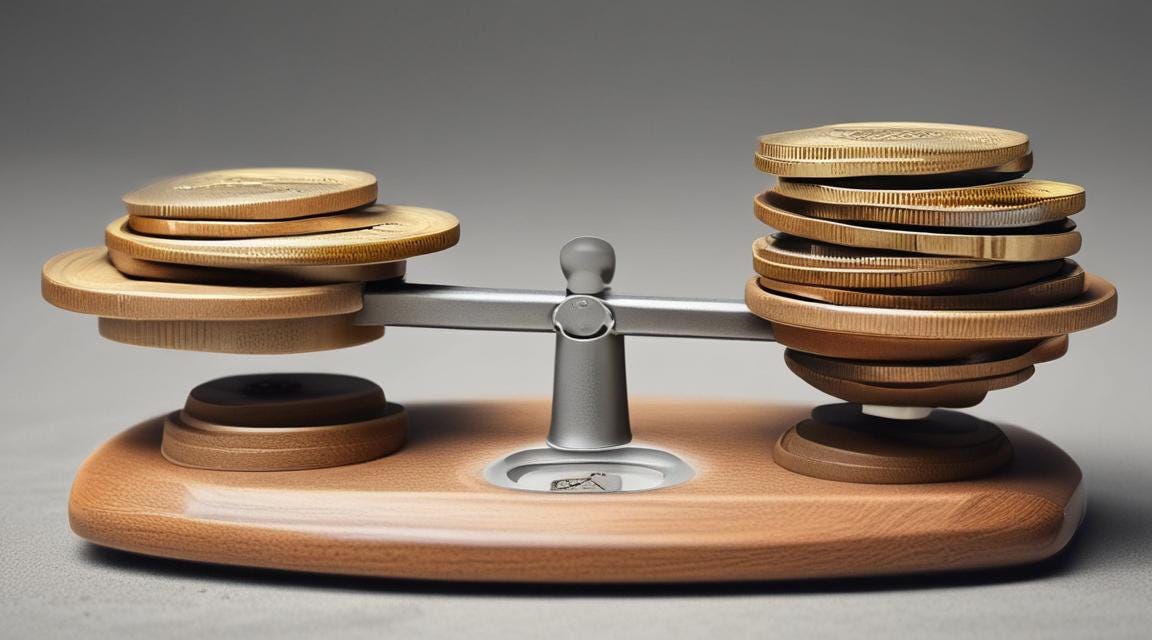
Now, let's consider the case where the first weighing balances. We have four coins left. We can use 3 known good coins, and weigh them against 3 of the suspect coins. This tells us if the remaining coin is counterfeit.
If the first weighing doesn't balance, let's say the left side is heavier. We know either one of the four coins on the left is heavy, or one of the four coins on the right is light. Let's take three from the heavier side and three from the lighter side. If this weighing balances, then we know the problem lies in the two coins remaining from the heavier group. If this weighs tips, then we can proceed accordingly. The problem is similarly solved if the first weigh tips to the right.
It turns out that with three weighings, you can pinpoint the counterfeit coin and determine whether it's heavier or lighter, but it only works with 12 coins. With 13 coins, there are 26 possible scenarios, making it impossible to solve in only three weighings! Each weighing must give us enough information to cut our possibilities down until only one possibility remains.
Birthday Match
Let's start by acknowledging that it's much easier to calculate the probability of not finding a match. What is this probability? If you ask one person, it's 364/365. Therefore1, for n people, it's (364/365)^n.
We want this quantity to fall below 50% and find the value of n where this happens. In other words, we need to solve for n in the inequality:
Solving this directly requires some trial and error or computational tools, but we can use an approximation. For large m,
Applying this approximation to our inequality, we get:
If you thought the answer to the puzzle was 23, you likely confused this question with the more famous “birthday paradox”, which asks how many people you need in a room to have a better than 50% probability that at least two people share a birthday.
As always, let me know in the comments if you found any better solution for any of these puzzles or if you have any brainteaser requests for future installments. See you next time!
We are implicitly assuming: (a) neither you nor anyone else on board was born on February 29, (b) other dates are equally likely to be a given shipmate’s birthday, and (c) there are no sets of twins on board.
Without looking at hints i would say :
1) If you hold it firmly but still allow friction you can turn indefinetely but otherwise i would say a bit more than a full rotation since you have the same amount of teeth and you can do a bit more.
2) Divide in the middle so you have 6 and 6, chose one group and measure if you can divide and it's a round number then chose group, split 3/3 and do the same (divide by 3 and chose the other) , finally split 2/1 and you have your answer by doing the same.
3) Given that you have 1/365 chance to have the same birthday, Those events are not link like a draw a ball and put the ball back, those events are independant, you can only hope to find someone like that ^^'